The Case for Loitering: Why Tollcross Deserves More Than a Passing Glance
Tollcross has a PR problem, and the problem is that it is useful. It is the place you pass through on the way to somewhere else: the clutch of traffic lights between Lothian Road and Fountainbridge, the spot where the bus groans and waits while everyone checks their phones. People know the junction. Fewer know the neighbourhood. That is a shame, because the Tollcross that exists once you stop treating it as a corridor is one of the most quietly rewarding corners of central Edinburgh.
The ninety-second neighbourhood
Think about how most people experience Tollcross. They come out of the King's Theatre, turn left or right, and disappear. They change buses at the lights. They walk from the Meadows towards the city centre and barely register the shift from Marchmont to Tollcross to Lothian Road. The place gets ninety seconds, maybe two minutes, and most of that is spent waiting for a green man.
But a neighbourhood is not a traffic management problem. Tollcross has its own rhythm, and it starts to show itself when you deliberately miss your connection. Stand still on Home Street for five minutes and you will see it: the bakery queue that forms before nine, the school run edging past the charity shops, the theatre crowd arriving early because the pubs are closer than the car park. This is not a pass-through. It is a place where people live, queue, complain about the bins and buy their milk.
Look up, then look again
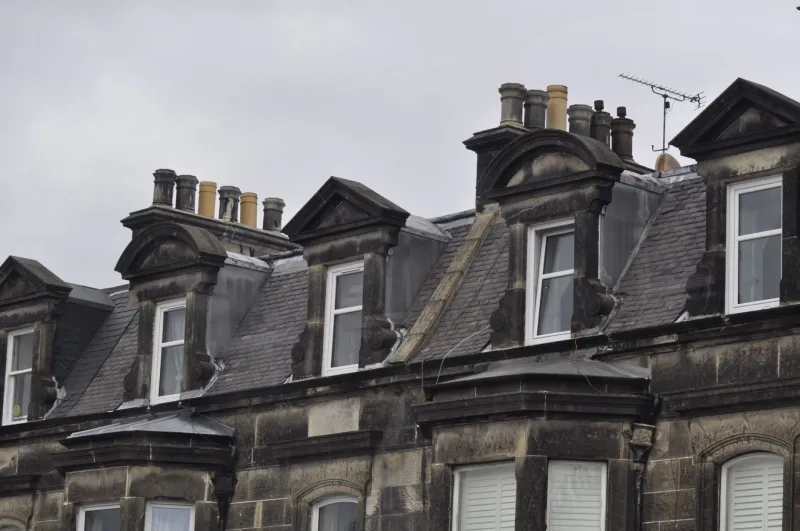
The first trick is to stop looking at eye level. Tollcross is not a grand set piece like the Royal Mile or a curated streetscape like parts of the New Town. Its architecture is better than it gets credit for, but it hides above the signage. Sandstone tenements with bay windows, carved lintels, the occasional date stone, shopfronts that have been adapted so many times that the old cornices no longer quite line up with the new fascia boards. On Leven Street, the theatre gives the street a natural anchor, but the buildings around it are doing their own quiet work. On Brougham Street, the scale drops and the detail increases. On Fountainbridge, old industrial edges sit alongside newer flats in a way that looks accidental until you realise it is just a city doing what cities do.
The second trick is to look at the small businesses rather than the big gestures. Tollcross is not short of ordinary shops doing useful things: a bakery that sells out of the good loaves by lunchtime, a greengrocer with crates on the pavement, a hardware shop that still understands the phrase 'just the one screw'. These are not attractions in the guidebook sense. They are the reason a neighbourhood feels like somewhere rather than a route.
The small economy of lingering
There is a practical argument here, not just a sentimental one. A neighbourhood that people linger in supports the kind of businesses that make city life bearable. The café that knows your order. The pub that is busy on a Tuesday because it is local, not because it is on a list. The newsagent who keeps the same paper aside. Tollcross has these places, but they only survive if people stop for long enough to use them.
The King's Theatre is the obvious engine. A full house spills out onto Leven Street and the surrounding streets, and suddenly the pavements are busy and the pubs are full. But the theatre crowd is a tide: it comes in and goes out. The locals' Tollcross is the one that exists on a wet Wednesday afternoon, when the theatre is dark and the junction is just a junction. That version of the neighbourhood is worth defending too.
A junction is still a place
It is easy to dismiss Tollcross because it lacks a single centrepiece. There is no square, no grand vista, no obvious 'here we are' moment. The name itself is a reminder that it was a crossing before it was a destination. But that is precisely what makes it interesting. It is a working junction, and working junctions have always been where cities mix: bus passengers, theatregoers, schoolchildren, office workers, people changing lines and people changing their minds about where to eat.
Lochrin Basin is a short walk away, and the canal towpath offers a sudden change of pace without leaving the area. The streets around Fountainbridge show the city's habit of layering new on old. Even the walk from Tollcross to the Meadows is a lesson in how quickly Edinburgh changes character, from traffic lights to tenements to trees in the space of a few minutes. You do not need a museum ticket to notice any of this. You just need to slow down.
How to cross less and stay longer
The locals' case for Tollcross is not that it is prettier than the city centre or more fashionable than Stockbridge. It is that it is ordinary in the best way: useful, mixed, slightly scruffy and full of small rituals. Get off the bus one stop early. Walk up Leven Street instead of past it. Buy something from a shop you have only ever looked into from a moving bus. Sit in a café window and watch the junction do its thing.
Tollcross will never be the postcard. It will be the place you cross. But cross it slowly, and it starts to feel less like a gap between better places and more like a neighbourhood with its own claim on your time.