Bar, Cross and Boundary Stone: Unpicking the Name Tollcross — and the Walk That Explains It
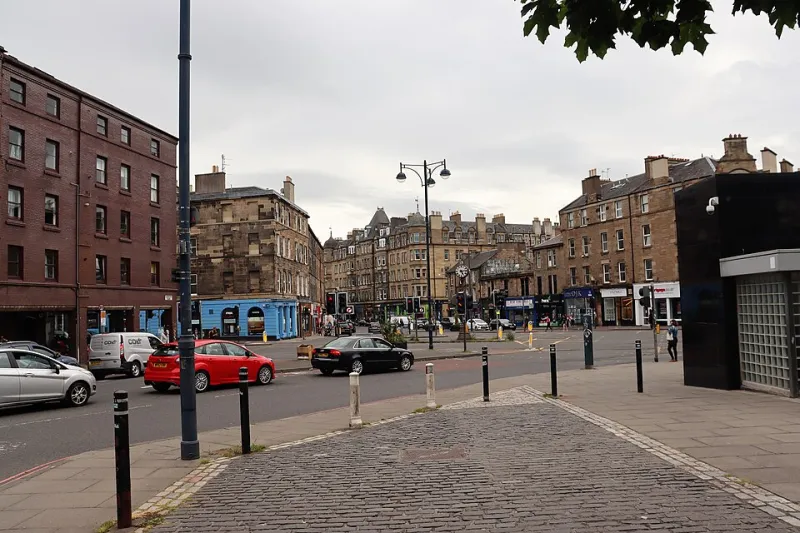
Photo: Stephen Craven , CC BY-SA 2.0, via Wikimedia Commons
Place names are receipts. They record something that happened there, often something tedious — a tax, a gate, a queue. Tollcross is one of the most honest examples in Edinburgh. Say the word out loud and you are describing, with reasonable accuracy, a small administrative inconvenience from the age of turnpike roads.
That's not a put-down. It's the key to the whole neighbourhood.
A bar was not a pub
In the eighteenth and early nineteenth centuries, Scottish roads were maintained by turnpike trusts, and turnpike trusts were funded by tolls. To collect them you needed a physical obstruction: a gate or a bar across the road, usually with a toll house beside it for the keeper. Travellers paid, the bar lifted, they went on their way.
The spot we now call Tollcross sat where routes out of Edinburgh divided — the road west towards Fountainbridge and Gorgie, and the road south-west through Bruntsfield towards Morningside and eventually the Borders. That fork made it a sensible place to intercept traffic in both directions. Hence the bar, and hence the cross beside it.
Local historians have argued over the 'cross' for years. One reading is a genuine wayside cross or market cross, the sort of marker that stood at the edge of a town to signal that you were entering somewhere with rules. The other is simpler: the cross at the toll. Either way, the thing itself is long gone, and nobody can point to the exact stone.
What the clock is — and isn't
The clock hanging over the corner at the junction is the landmark most people mean when they say 'meet you at the Tollcross clock'. It is not medieval, it is not the cross, and it has been fiddled with over the decades. What it is, is the direct descendant of the toll house in function: a piece of street furniture that tells you that you have arrived somewhere specific.
That job got more important in the tram era. Tollcross was a junction for the city's tram network, and a clock over a junction is what you build when people are changing vehicles and need to know whether they've missed one. The trams went, the clock stayed, and it has been the neighbourhood's front door ever since.
The boundary stones
Look closely at older walls and corners on the south side of the city and you'll still find inscribed stones marking where Edinburgh ended and something else began. Some read variations on 'City of Edinburgh Boundary'. They survive in odd numbers because the line moved outward in stages through the later nineteenth and early twentieth centuries, leaving each old marker stranded well inside the new city.
That's the real story of Tollcross: the edge kept moving past it. For a long stretch it was genuinely the last built-up bit before the road gave out — the place where the town stopped and the toll was paid. Then the city grew around it, and what had been a boundary became a junction.
The stones are worth hunting for, but don't expect signage or a leaflet. Ask at a local library or a history group and you'll get a better answer than any plaque.
Walk it yourself — about 45 minutes
A short loop that keeps the name in view the whole way.
1. The junction. Stand at Tollcross and look up at the clock. Picture a gate across the road, because that is, in essence, what you're standing under.
2. Leven Street. Walk south past the King's Theatre. Opened in 1906, it arrived when the area was already dense and busy — a sign of a district that had stopped being a boundary and started being a destination.
3. Brougham Street and Spittal Street. Cut through and look at the upper floors and old shopfronts. This is the street pattern of a coaching-era crossroads that got built over rather than planned.
4. Bruntsfield Place and the Links. Head south-west to Bruntsfield Links, one of the oldest public golfing grounds anywhere, and the Golf Tavern at its edge — a pub site with genuinely deep roots. This was the countryside end of the old toll road, and it still feels marginally looser than the streets behind you.
5. Boundary spotting. Wander the quieter residential streets between Bruntsfield and Morningside and keep an eye on wall heads and gateposts. Inscribed stones turn up where you least expect them.
6. Back by the Meadows. Return along Melville Drive and cross the park, or follow the lit streets if it's dark. Finish at the junction again, ideally in a pub, ideally with the clock in sight.
Sidebar: the people who kept the edge
Tollcross has a long habit of being defended by people who live and trade there. When the King's Theatre was under threat of closure in the twentieth century, it was sustained by local campaigning and public pressure rather than by any grand strategic plan — and it remains a theatre in a residential district rather than a district that happens to contain a theatre. The Cameo, further along Home Street, has been rescued more than once by people who simply refused to accept that a good cinema should become anything else.
That instinct shows up in smaller ways too. Traders' groups and the community councils covering the Tollcross and Southside area have spent years arguing about bins, crossings, licensing and street clutter — unglamorous work that determines whether a crossroads feels like a place or just a gap between traffic lights. The neighbourhood has also held onto its own name against periodic attempts to fold it into grander-sounding surroundings. Tollcross it was, and Tollcross it has remained.
Why the edge still matters
Here's the thing about a place defined by a boundary: it never quite loses the habit. Tollcross today is a junction before it is a destination — people pass through it on the way to the cinema, the theatre, the park, the office. Residents will tell you the area is a bit scruffy, a bit transitional, and that you can get anywhere in ten minutes.
That's the toll bar talking. A place built to intercept people on their way somewhere else has never needed to be precious about itself, and that's exactly what makes it useful. The name is a receipt, and the goods are still on the shelf.