Coal Holes and Tram Scars: A Tollcross Walk That Never Looks Up
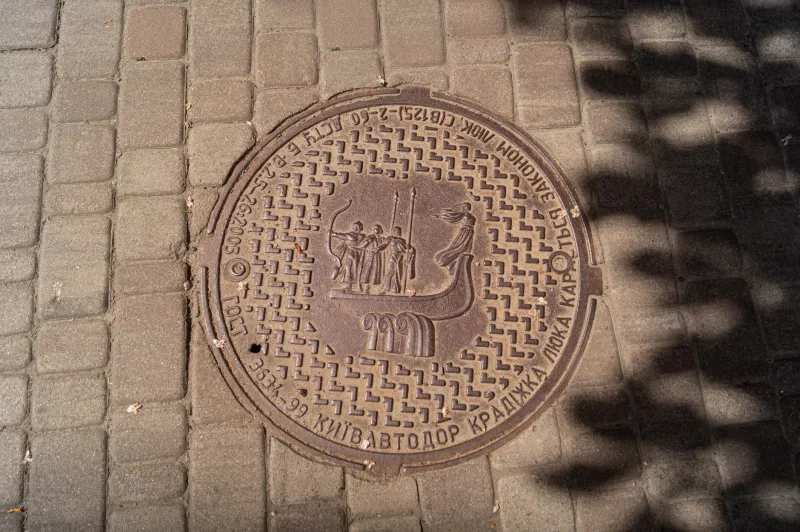
Most people walk through Tollcross with their chin up. Fair enough: the King's Theatre puts on a show even when it's dark, the tenements have more cornice than they strictly need, and the junction itself is a piece of Victorian traffic planning that still looks faintly surprised to be there. But there's a second Tollcross under your feet, cast in iron, and it's arguably more honest about the place. Coal holes, drain covers, tram scars, stop-cock plates, hydrant lids — a street's paperwork, stamped and bolted down.
This is a walk for a bright, cold morning, or the hour after rain when the metal goes dark and the lettering suddenly reads itself. Allow 45 minutes. Bring nothing except shoes you don't mind getting wet.
Start where the roads collide
Begin on the wide pavement at the Tollcross junction, on the side where the crossings meet. Don't stand in the road to admire anything — this is a working junction and the buses are not sentimental. Instead, look at the kerb line and the gutter. You'll see rectangular drain gratings set flush with the setts, and around them a patchwork of repairs in different shades of grey. That patchwork is a timeline. Roads get dug up, patched, dug up again, and the ironwork is the only part that gets reused.
Look for a maker's name running along the edge of a cover. Many are worn to a whisper; a few still carry a foundry name and a town — Falkirk, Glasgow, occasionally somewhere smaller. These are the signatures of the walk, and they're the reason to bring a phone camera rather than a notebook.
What you're actually looking for
Four families of iron, roughly.
Coal-hole plates. These are the stars. Flat cast-iron plates set into tenement pavements, sometimes round, more often rectangular, often lettered COALS. They cover the chute down to a cellar where coal was tipped. In streets like these, where the coal cellars were the original heating system, the plates are the last surviving evidence of how the buildings actually ran. Some sit in neat rows outside a close; others are half-buried in later tarmac, which tells you the cellar was abandoned rather than removed.
Do not lift one. They're heavy, they're often rusted through, they belong to someone, and a missing cover is a genuine hazard. Look, photograph, move on.
Drain and service covers. Squares and rectangles with patterns of raised studs, sometimes lettered with a water or gas authority that no longer exists. Wear patterns matter: a cover polished smooth down the middle means decades of feet taking the same line.
Tram scars. Edinburgh's trams stopped in 1956, and the routes along Home Street and Gilmore Place left marks that aren't always obvious. Look for long lines of setts surviving in an otherwise asphalted stretch, thin strips of iron set flush along a road's centre, and occasional rails glimpsed at the edge of a repair. Where a road widens oddly, or a building sits at a strange angle to the kerb, a tram route is often the reason.
Small plates. Stop-cock lids, hydrant markers, tiny squares lettered with initials. They're the least glamorous and the most numerous, and collectively they map the underground plumbing of the neighbourhood better than any drawing.
The loop, in order
Head west along Home Street, downhill, keeping to the pavement and checking the tenement side. This is prime coal-hole territory: look near closes and shop thresholds. Shop doors are worth a glance too — old ironmonger or tramway plates sometimes survive by a step, worn to a brass shine.
At the Fountainbridge end, turn and come back on the other side, then take Leven Street past the theatre. The iron here is heavily used and heavily repaired, which is its own kind of history: a century of queueing, loading, sweeping and resurfacing.
Climb Gilmore Place and watch the road surface rather than the shopfronts. This is where the setts and strips are most visible, especially in low winter light, when every lump in the tarmac casts a shadow. Then drop down Brougham Street and Brougham Place for the quieter residential plates — fewer feet, better lettering.
Finish along Earl Grey Street back to the junction. By now you'll have trained your eye, and the last stretch will feel like re-reading a page you thought you knew.
How to read a plate without being a nuisance
Light is everything. Flat midday sun will hide the relief; low sun, or the twenty minutes after rain, will reveal it. Photograph straight down with something for scale — a coin, a key — so you can compare plates later. Side-on shots at a low angle pick up maker's marks that are invisible from standing height.
A pencil and thin paper will take a rubbing off a dry cover, but only where it's clean and safe to kneel. Don't scrub anything, don't chip paint, don't block a close entrance, and don't crouch in a cycle lane. If a cover is broken or missing, note the location and tell the council rather than trying to make it good yourself.
What the ironwork actually tells you
Three things, mostly. First, fuel: the density of coal holes tells you which streets were built for coal and when the cellars fell out of use. Second, traffic: tram scars explain road widths, corner radii and the odd gap where a building should be. Third, maintenance: the mix of old plates and new covers shows which bits of pavement get dug up most, which usually means which bits have the oldest pipes.
There's a quieter pleasure too. Foundry marks are the signatures of people who made something designed to be walked on and forgotten. A hundred and thirty years later, you're standing on it, reading their name.
Practical notes
Wear shoes with a bit of grip — wet cast iron on a slope is genuinely slippery. Go on a weekday morning if you want fewer feet in your photographs. No group, no booking, no admission. Start at the junction, finish at the junction, and buy a coffee on the way round; you'll have earned it by the top of Gilmore Place.
And next time you're heading for the theatre or the shops, try the last fifty metres with your chin down. Tollcross has been keeping these records for well over a century. It doesn't mind if you finally read them.